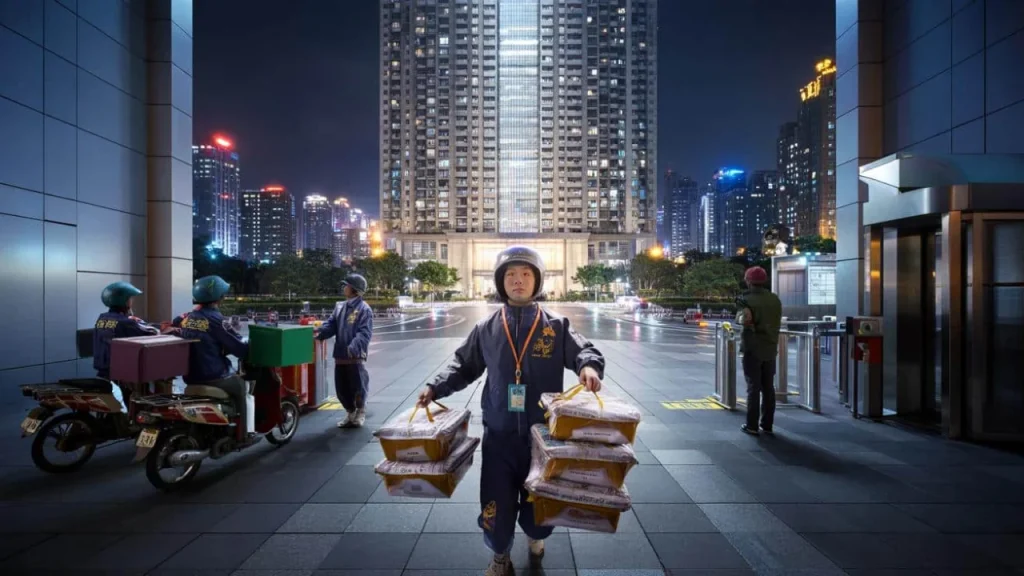

Li Wei clutches three steaming takeout bags in one hand and swipes his access card with the other. The elevator doors close, and he begins his familiar journey to the 47th floor. Twenty minutes ago, he was watching TV in his apartment. Now he’s earning 15 yuan delivering dinner to neighbors he’s never met.
This isn’t your typical delivery story. Li doesn’t own a scooter or brave traffic jams. He’s part of China’s newest gig economy phenomenon: skyscraper delivery workers who exist solely to bridge the gap between street-level couriers and sky-high apartments.
In cities where residential towers stretch 60 floors into the clouds, getting food from the lobby to your door has become a job in itself.
When Buildings Outgrow Their Systems
Shenzhen transformed from fishing villages to a sprawling metropolis in just four decades. The city’s hunger for space pushed developers to build up, not out. Today, residential complexes routinely house 3,000 families in towers that pierce the sky.
But here’s the problem nobody anticipated: traditional food delivery breaks down in super-tall buildings. External couriers spend 15-20 minutes navigating security, waiting for elevators, and hunting for apartment numbers. With payment systems based on completed orders, not time invested, every minute stuck in a building costs money.
“Regular delivery riders can complete six to eight orders per hour on street level,” explains Chen Ming, a logistics consultant in Shenzhen. “In a 60-floor tower, they’re lucky to finish two.”
The math forced delivery companies to adapt. Rather than lose money on vertical routes, they began dropping orders in bulk at building entrances. This created a gap that local entrepreneurs quickly filled.
Inside the World of Relay Delivery
Skyscraper delivery workers operate in a unique ecosystem. Most live within the buildings they serve, giving them instant access and intimate knowledge of layouts, elevator patterns, and security procedures. They work flexible hours, often accepting jobs through WeChat groups or building management apps.
Here’s how the system typically works:
- External courier arrives with multiple orders for the building
- Relay worker meets them in the lobby
- Orders are transferred, usually photographed for proof
- Relay worker handles security clearance and elevator access
- Final delivery to individual apartments
- Payment splits between external courier and relay worker
| Building Height | Average Delivery Time | Relay Worker Earnings per Run |
|---|---|---|
| 20-30 floors | 8-12 minutes | 3-5 yuan |
| 30-50 floors | 12-18 minutes | 5-8 yuan |
| 50+ floors | 18-25 minutes | 8-15 yuan |
During peak dinner hours, the lobbies of mega-towers resemble miniature logistics centers. Relay workers coordinate through smartphones, managing multiple orders while external couriers queue outside with thermal bags.
“I can make 80-120 yuan on a busy evening,” says Wang Xiaoli, who covers floors 30-45 in her Shenzhen complex. “It’s not full-time income, but it pays for groceries.”
The Human Cost of Vertical Cities
This new profession reveals something profound about China’s urban evolution. When cities grow faster than infrastructure can adapt, people create solutions. But these solutions often come with hidden costs.
Skyscraper delivery workers face unique challenges. They navigate complex building politics, deal with suspicious security guards, and manage relationships with dozens of neighbors. Some buildings restrict access times or require special permits. Others charge fees for commercial deliveries.
“Building management sees us as somewhere between residents and businesses,” explains Liu Gang, who works in three different towers in Guangzhou. “We’re useful but not always welcome.”
The job also highlights China’s gig economy expansion. Like ride-sharing drivers or bike mechanics, relay workers fill gaps in formal employment. They’re typically middle-aged residents, retirees, or people between jobs who value flexibility over security.
For residents, the system works remarkably well. Delivery times remain reasonable, and costs stay low. Food arrives hot, and the process feels seamless. But it depends entirely on informal networks and personal relationships.
“When my regular relay guy goes on vacation, suddenly getting dinner becomes complicated,” admits Zhang Mei, who lives on the 52nd floor of a Shenzhen tower. “You realize how much you depend on these invisible workers.”
What This Means for Urban Planning
The rise of skyscraper delivery workers signals broader changes in how cities function. As more people live in vertical communities, new service industries emerge to bridge physical and logistical gaps.
Urban planners are starting to notice. Some new developments include dedicated delivery elevators or staging areas. Others experiment with automated systems, though these remain expensive and unreliable.
“We’re essentially watching cities learn to be taller,” observes Dr. Sarah Chen, an urban development researcher. “The solutions people create today become tomorrow’s infrastructure requirements.”
The phenomenon isn’t limited to China. Similar relay systems appear in dense cities worldwide, from Mumbai’s high-rises to New York’s luxury towers. As urban populations concentrate in vertical spaces, the basic challenge of moving things up and down becomes increasingly complex.
For now, human ingenuity fills the gaps. Skyscraper delivery workers represent both the problems and solutions of extreme urban density. They’re proof that when cities outpace their systems, people find ways to make things work.
Whether this remains a sustainable solution depends on factors beyond individual workers’ control: building regulations, labor laws, and the ongoing evolution of urban logistics. But for millions of residents in China’s tallest towers, these relay workers have become an essential part of daily life.
FAQs
How much do skyscraper delivery workers earn?
Earnings vary by building height and location, typically ranging from 3-15 yuan per delivery run, with busy workers making 80-120 yuan during peak hours.
Do delivery companies officially employ these relay workers?
No, most relay workers are independent contractors who coordinate informally with external couriers and building residents through messaging apps.
Why don’t regular delivery workers just go up themselves?
Time constraints and payment structures make it unprofitable for external couriers to spend 15-20 minutes navigating tall buildings when they could complete multiple street-level deliveries instead.
Is this job legal in China?
Yes, though it operates in regulatory gray areas regarding building access, commercial activity in residential spaces, and informal employment arrangements.
Are similar systems developing in other countries?
Yes, relay delivery systems appear in dense urban areas worldwide, though they’re most developed in Chinese cities due to the combination of extreme building heights and mass delivery culture.
What happens if the relay worker isn’t available?
Deliveries typically get delayed or canceled, highlighting residents’ dependence on these informal networks for basic services like food delivery.